

First-Time Donor Retention: Why Donors Ghost and How to Stop It
If your first-time donors seem to vanish the moment their receipt hits their inbox, you’re not imagining it. And it’s not a “donor problem.”
It’s a systems problem.
Most nonprofits lose the second gift long before they realize anything is slipping. The donor cared. The mission resonated. But the follow-up window closed before your team had a chance to act.
When timing, tagging, and workflows aren’t in place, donors slip through the cracks.
Here's what's actually happening—and a 30-day plan for both first-time donors and the ones who already slipped away.
Why a donation receipt isn't enough to retain first-time donors
A receipt acknowledges the gift. A heartfelt thank you begins the relationship.
But thank yous pile up. The longer you wait to send thank-yous, the more intimidating they become. A day turns into a week, a week turns into “I’ll do it tomorrow,” and suddenly you have a stack of overdue gratitude staring at you like a to-do list with feelings.
Automate your donor thank-you within 24–48 hours
Use your CRM and Zapier to create an automated thank you that lands within 24–48 hours, every time.
When your system prepares the draft automatically, you remove the bottleneck. Instead of starting cold, you’re adding the human touch to something already in motion.
Your early emails are all about you—and donors can tell.
Before organizations come to us, their donor emails say "we," "our," and "Here at Org Name" more than we care to count. Sometimes every email ends with an ask. Or worse, nonprofits don't send anything at all—paralyzed by the fear of overdoing it.
(How many times has a board member complained you send too many emails? You're not alone.)
Early communication has one job: show the donor the difference they helped create.
A thank-you followed by another ask lands flat. A thank-you followed by impact builds trust. That's why every donor sequence we write starts with the donor at the center—not the organization. We call it conversational copywriting, and it's built around one simple shift:
Instead of: “Thank you for your gift. Now here are three more ways to give.”
Try: “Thank you for your gift. Here’s a recent moment that shows the impact you make possible.”
You don’t need a long story. Just one detail, one moment, one transformation connected to their gift.
Trigger an impact touchpoint after every gift
Use tags or smart segmentation in your CRM to automatically trigger a short impact email a few days after the initial thank-you. No scrambling, no remembering. Your system queues it, you approve it, and the donor feels seen.
Disconnected systems are killing your donor retention
When donor data lives across multiple tools, when tags don’t sync, and when follow-up depends on “someone remembering,” your timing falls apart. And delay is expensive.
Bloomerang highlights research showing that the five-year value of a donor is directly tied to how quickly the second gift happens. Donors who give again within the first three months—the “golden window”—are exponentially more valuable than those who drift for a year.
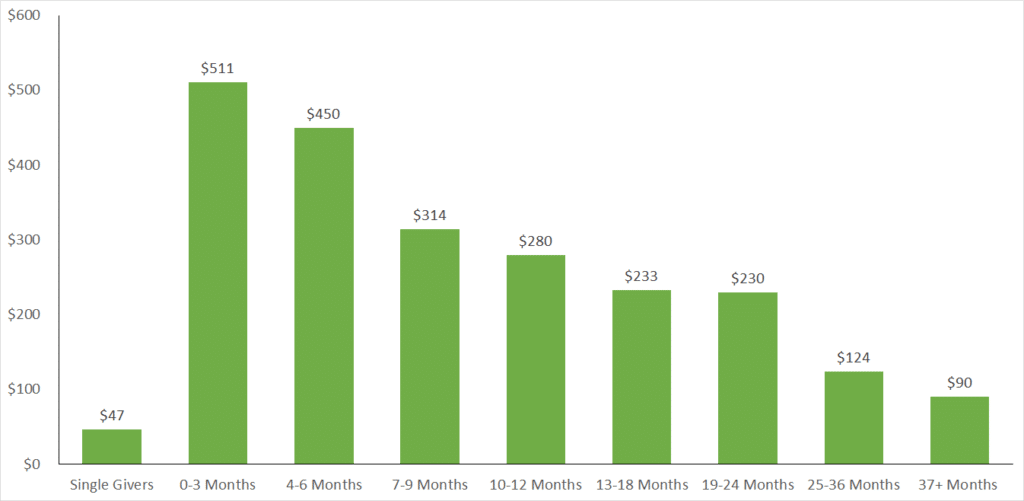
Source: Analytical Ones - Five-year donor value by time to second gift
If your setup takes two weeks to thank someone, or your welcome series never fires because a tag didn’t carry over, you lose the moment where donors are most likely to engage again.
Automate your tagging, triggers, and first touchpoint
Close the gaps your manual process can’t catch.
When a new gift comes in, your system should automatically tag the donor, trigger the thank-you draft, and queue the first touchpoint in your welcome sequence—all without anyone on your team having to remember it.
That's what a connected tech stack does. Your CRM and Zapier handle the timing so you can handle the relationship.
Not sure where your gaps are? Our tech audit is usually where we start—we map your current setup, find where donors are slipping through, and build the automations that catch them.
How to re-engage lapsed donors in 30 days
Donor ghosting doesn’t stop on its own. You fix it with a clear donor journey and a follow-up system that doesn’t depend on your memory or your to-do list.
That means reaching out to the donors who drifted and building a structure that keeps new donors close.
Before you can welcome new donors well, you need to circle back to the ones who slipped away. Here’s an email sequence you can build in the next 30-days to remind donors why their gift mattered.
Week 1: Send a warm, “we’ve missed you” note
This will be a quick, personal email without any pressure. Write it once and use it as your template. (Just remember: no long mission statements or copy-and-pasting paragraphs from your annual report).
Week 2: Show donors what’s new
Think of this as a friendly catch-up. Share a small win, a quick impact snapshot, or a behind-the-scenes moment that feels alive and human.
The goal is to help them remember the feeling that made them give in the first place.
Week 3: Invite them into a conversation
Send a 2–3 question micro-survey and ask:
What inspired you to give?
What updates do you like most?
How often do you want to hear from us?
This helps you reset expectations and rebuild the relationship.
Week 4: Offer a soft next step
Once they’ve had a chance to reconnect with your work, you can gently open the door for them to get involved again. Keep it simple with an invite to follow you on social media or learn more about a program.
How to retain first-time donors with a 30-day welcome sequence
Having a welcome series can help raise first-time donor retention by 5-10 percent. If you want donors to stick around, you need a welcome series that keeps the conversation going.
With a welcome series in place, organizations we work with see first-time donor retention climb from roughly 18% to the 35–48% range—because the donor never experiences that silence after the gift.
Week 1: Send a warm, personal welcome
This goes out within 24–48 hours of the gift—ideally automated so it never slips. Keep it short, donor-centered, and focused on one thing: making them feel like their gift landed somewhere that noticed. No mission statements. No second ask. Just a genuine, human welcome.
Week 2: Show them their gift in action
Share one specific impact moment—a story, a stat, a behind-the-scenes detail that connects their dollars to something real. This is the email that builds trust and makes the donor feel like an insider, not a transaction.
Week 3: Introduce them into your world
Help them go deeper without asking for anything. Share a piece of content they'd find useful or introduce them to a program they might not know about. The goal is engagement, not conversion.
Week 4: Make a soft, easy-lift ask
By now, donors have been welcomed, seen impact, and gotten to know you. Keep this one simple and low-pressure. Some ideas:
Invite new donors on a facility tour
Ask them to share your social media with a friend
Introduce them to a volunteer opportunity
The goal is to deepen the relationship, not convert it. That comes later.
Ready to stop losing first-time donors?
Download 5 Ways to Automate Your Donor Stewardship—a free guide to the exact workflows that turn first-time donors into loyal, long-term supporters.
